What Are Progressive Lenses? Progressive lenses let you see clearly at all distances in one pair of glasses. Learn how they work, types, costs, pros & cons, and how to choose the right ones. If you’ve recently been told you need reading glasses — or you’re tired of constantly switching between multiple pairs — progressive lenses might be exactly what you’re looking for. These multifocal lenses offer a seamless visual experience across all distances: reading a menu, working at your computer, and spotting someone across the room, all through one pair of glasses.
Progressive lenses are now the most popular multifocal lens solution worldwide, and for good reason. Unlike bifocals or trifocals, they contain no visible lines and offer a smooth, gradual change in prescription power from top to bottom. For the millions of adults who develop presbyopia after age 40, they’ve become an essential everyday tool.
This guide covers everything you need to know: how progressive lenses work, the different types available, their pros and cons, how they compare to bifocals, how much they cost, what to expect during the adaptation period, and how to choose the right pair for your lifestyle.
What Are Progressive Lenses?
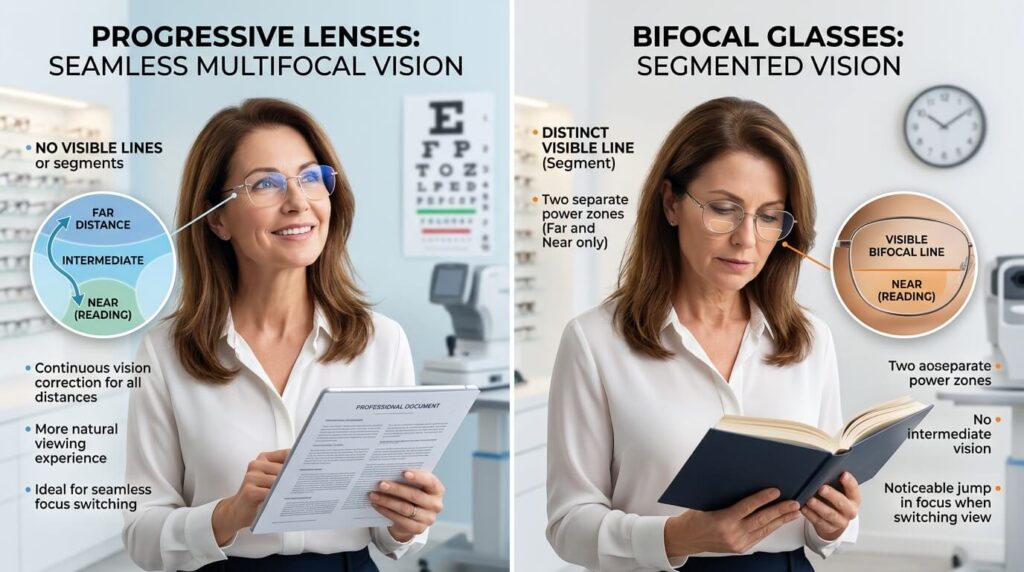
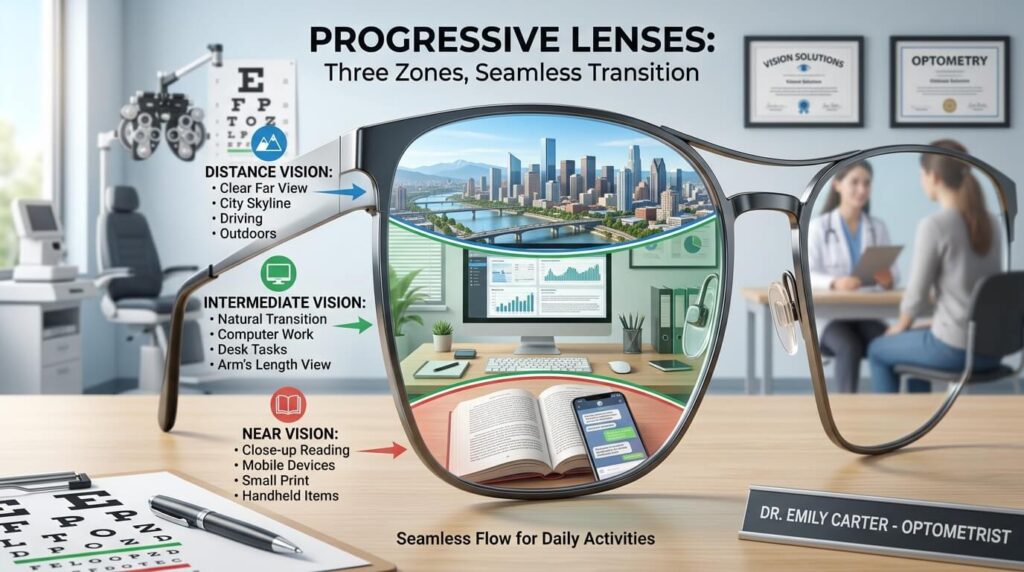
Progressive lenses — also called progressive addition lenses (PALs) or no-line multifocal lenses — are eyeglass lenses that correct vision at three distinct focal distances within a single lens, without any visible lines separating the zones.
- The upper portion of the lens corrects distance vision (driving, watching TV, seeing faces across a room).
- The middle corridor corrects intermediate vision (computer screens, dashboards, store shelves).
- The lower portion corrects near vision (reading, texting, crafts).
The prescription power changes gradually as your gaze moves downward through the lens, creating a smooth transition between zones. This “progressive” change in lens power is where the name comes from.
How Are Progressive Lenses Different from Bifocals and Trifocals?
Bifocals contain two prescription zones with a visible line separating them — distance at the top, near at the bottom. Trifocals add a third zone (intermediate) with two visible dividing lines.
Progressive lenses provide all three focal zones but use a seamless, gradual power gradient rather than abrupt lines. This eliminates the “image jump” phenomenon — the jarring visual shift your eyes experience when crossing the lines in bifocals or trifocals.
Who Needs Progressive Lenses?
Progressive lenses are most commonly prescribed for:
- Adults with presbyopia — the age-related loss of near focusing ability that affects nearly everyone after 40. It occurs as the eye’s crystalline lens gradually loses flexibility.
- Children with myopia (nearsightedness) — in some cases, progressive lenses are prescribed to help slow myopia progression.
- People with multiple prescriptions — anyone who currently juggles reading glasses and distance glasses.
How Do Progressive Lenses Work?
The optical engineering behind progressive lenses is remarkably sophisticated. The lens surface is computed with varying curvatures that create a continuous gradient of increasing “add power” (the extra magnification needed for near vision) as you move from the top of the lens downward.
This gradient runs through a central corridor called the progressive corridor or channel. To read, you look through the lower part of this corridor. To see far away, you look through the top. For intermediate distances — your computer screen, for example — you look through the middle.
The width of this corridor matters significantly. Wider corridors provide a larger clear viewing area but require a taller lens frame. Shorter corridors fit compact frames but trade off some clarity at the edges of each zone.
On either side of the progressive corridor are areas of “peripheral distortion” — zones where the optical power transitions rapidly, causing some blurriness or waviness when you look too far to the sides. This is an inherent optical trade-off in all progressive lens designs, though advanced freeform technology has reduced it substantially.
The Role of Pupillary Distance (PD)
For progressive lenses to work correctly, your optician must measure your pupillary distance (PD) — the distance between the centers of your pupils. For progressives, a near PD and distance PD are often measured separately, as your pupils converge slightly when focusing up close. An incorrect PD measurement is one of the most common reasons people struggle to adapt to progressive lenses.
Types of Progressive Lenses
Not all progressive lenses are created equal. The technology, manufacturing method, and intended use case vary significantly across different types. Understanding these differences helps you and your eye care provider choose the right lens for your needs.
1. Conventional (Standard) Progressive Lenses
These are the original progressive lens design, manufactured using traditional surfacing methods. The lens power is molded into the front surface of the lens during production, with minimal personalization.
Key characteristics:
- Affordable entry-level option
- Limited customization; not tailored to your specific face or frame
- Narrower intermediate and near vision zones
- More noticeable peripheral distortion compared to newer designs
- Require frames with sufficient vertical height (typically 28mm+)
Best for: Budget-conscious wearers with straightforward prescriptions who are new to progressives.
2. Entry-Level Freeform Progressive Lenses
Freeform manufacturing uses computer-controlled diamond-tipped tools to grind the lens surface with extreme precision, producing smoother power transitions and wider clear zones than conventional lenses.
Entry-level freeform lenses use standard parameters rather than fully personalized data, but already offer meaningful improvements over conventional designs.
Key characteristics:
- Wider fields of clear vision
- Reduced peripheral aberrations
- Better for higher prescriptions
- More consistent lens quality
Best for: Wearers with moderate to high prescriptions or those who struggled to adapt to conventional lenses.
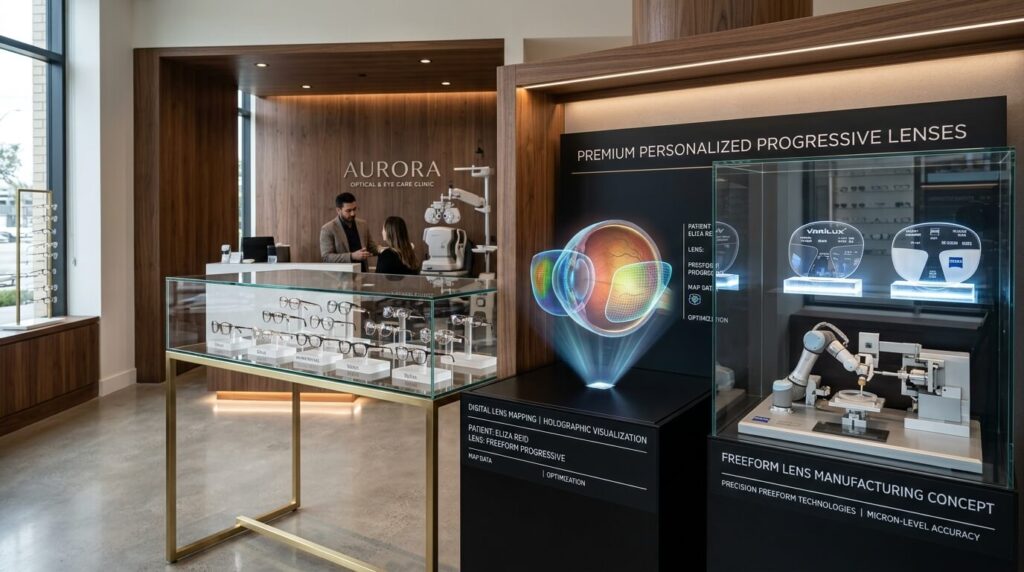
3. Advanced (Personalized) Freeform Progressive Lenses
These are the premium tier of progressive lenses, fully customized using detailed measurements that go far beyond a standard prescription. The lab receives data about your dominant eye, frame tilt (pantoscopic angle), face wrap, vertex distance (the gap between the lens and your eye), and even your preferred reading distance.
Subtypes within advanced freeform:
Personalized freeform progressives account for your unique eye anatomy, dominant eye, and frame geometry. The result is an exceptionally tailored lens that reduces adaptation time and minimizes peripheral distortion.
Dual-surface progressives distribute the progressive power across both the front and back surfaces of the lens rather than concentrating it all on one surface. This produces a more balanced, wider field of vision across all zones with reduced swim effects, and is particularly beneficial for complex prescriptions.
Key characteristics:
- Widest, clearest fields of view
- Fastest adaptation time
- Most effective for complex prescriptions
- Significant reduction in peripheral distortion
- Higher cost reflecting advanced manufacturing
Best for: Demanding wearers, first-time progressive wearers who want the easiest adaptation, and those with complex prescriptions.
4. Short Corridor Progressive Lenses
Designed for smaller, fashionable frames, short corridor lenses compress the progressive zone to fit frames with limited vertical height (often under 30mm).
Key characteristics:
- Compatible with compact, trendy frames
- Quicker visual transition from distance to near
- Narrower reading zone
- Reduced intermediate vision area
Best for: Style-conscious wearers or those with smaller faces who prefer compact eyewear.
Important note: Short corridor lenses require a longer adaptation period for most wearers due to their narrow zones. Your optometrist should discuss this trade-off with you before prescribing them.
5. Lifestyle Progressive Lenses
These lenses are weighted toward the visual zones you use most based on your daily activities.
Distance-weighted progressives emphasize the upper distance zone, providing a wider, clearer field for outdoor activities, driving, and environments requiring sustained far vision. Ideal for active individuals, golfers, and hikers.
Intermediate-weighted progressives prioritize the middle zone and are often recommended for first-time progressive wearers. They are generally easier to adapt to, though the trade-off is that distance and near zones are somewhat compressed.
Near-weighted progressives expand the lower near vision zone for people who spend most of their time reading, crafting, or doing close-up work indoors.
6. Computer (Occupational) Progressive Lenses
Designed specifically for office and screen-based environments, computer progressive lenses prioritize the intermediate zone (typically covering distances of 40cm to 2–4 meters), providing a wider, more comfortable area for computer work, tablet use, and reading.
Key characteristics:
- Significantly wider intermediate and near zones than general-purpose progressives
- Reduces eye strain and digital eye fatigue
- Not suitable for driving (limited distance correction)
- Ideal for 4+ hours of daily screen time
Many wearers who spend long hours at computers keep a pair of computer progressives at their desk and use general-purpose progressives for driving and outdoor activities. This combination approach maximizes visual comfort throughout the day.
7. Task-Specific Progressive Lenses
These highly specialized lenses are engineered for a single primary activity.
Driving progressives expand the upper intermediate zone and reduce lateral astigmatism for clearer road and dashboard vision, including improved night driving clarity.
Sport progressives shift emphasis even further toward distance with a nearly panoramic distance zone, with intermediate and near zones positioned low in the lens. Excellent for tennis, cycling, or skiing.
Pilot progressives expand the upper intermediate zone to bring overhead instrument panels into sharp focus — a reversal of the typical progressive hierarchy.
Golf progressives (ground-view) reposition the near zone for comfortable downward viewing at the tee, fairway, and scorecard without excessive head tilting.
8. Photochromic Progressive Lenses
These combine progressive multifocal optics with photochromic technology (such as Transitions™). The lenses automatically darken outdoors in UV light and return to clear indoors, offering UV protection, glare reduction, and multifocal vision in one product.
Key characteristics:
- Convenient all-in-one solution for indoor/outdoor wearers
- Block 100% of UV-A and UV-B radiation
- May include blue light filtering
- Varying fade-back speeds depending on temperature and brand
Progressive Lens Comparison Table
$–$$–$
| Type | Best For | Customization | Clear Zone Width | Cost Range | Key Drawback |
|---|---|---|---|---|---|
| Conventional | Budget buyers, simple Rx | Minimal | Narrow | $ | Most peripheral distortion |
| Entry-Level Freeform | High Rx, adaptation challenges | Moderate | Moderate | $$ | Less personalized than premium |
| Advanced Personalized | Demanding wearers, first-timers | High | Wide | $$$ | Higher cost |
| Dual-Surface | Complex prescriptions | High | Widest | $$$$ | Less common |
| Short Corridor | Small frames, fashion eyewear | Moderate | Narrow | $$ | Longer adaptation |
| Lifestyle (Distance) | Outdoor, active lifestyles | Moderate | Wide distance | $$ | Smaller near zone |
| Lifestyle (Intermediate) | New wearers, general use | Moderate | Balanced | $$ | Narrowed distance/near |
| Lifestyle (Near) | Readers, indoor workers | Moderate | Wide near | $$ | Limited distance clarity |
| Computer | Office, screen users | Moderate | Wide intermediate | $$ | No driving use |
| Task-Specific (Sport/Drive) | Athletes, drivers | Highest | Activity-specific | Limited versatility | |
| Photochromic | Frequent indoor/outdoor transitions | Moderate | Moderate | Slower darkening in cars |
Progressive Lenses: Pros and Cons
Advantages
One pair does everything. You no longer need to carry and manage multiple pairs of glasses for reading, computing, and driving. Most wearers report significantly greater convenience.
No visible lines. Unlike bifocals and trifocals, progressive lenses have no demarcation lines. Many wearers, particularly younger adults developing presbyopia, prefer the discreet appearance.
Smooth visual transitions. No image jump — the jarring shift in vision that occurs when crossing the lines in bifocals. Progressive lenses provide a natural, continuous visual experience.
Full intermediate vision. Bifocals have no intermediate zone at all. For modern lifestyles dominated by computer screens, this is a major advantage of progressives.
Cosmetically younger appearance. The absence of lines makes it impossible for others to identify your lenses as multifocals, which matters to many wearers.
Disadvantages
Adaptation period required. Most new progressive lens wearers experience 1–2 weeks of adjustment as their brain learns to use each zone of the lens correctly. Some wearers take up to 8 weeks; a small percentage never fully adapts.
Peripheral distortion. The nature of progressive lens optics creates blurry or distorted areas toward the edges and corners of the lens. Advanced freeform designs minimize this, but it cannot be entirely eliminated.
Higher cost. Progressive lenses are more expensive than bifocals, single vision lenses, or trifocals, particularly premium personalized designs.
Frame limitations. Not all frame shapes and sizes work well with progressives. Small or very narrow frames may not accommodate the full progressive zone.
Learning to move your head, not your eyes. Reading with progressive lenses requires moving your head to position your gaze through the correct zone, rather than just moving your eyes. This adjustment feels unnatural at first.
Progressive Lens Materials
The material your progressive lenses are made from affects their weight, thickness, optical clarity, impact resistance, and price.
CR-39 (plastic) is the traditional standard. Lightweight, optically clear, and easy to coat, but thicker than higher-index materials for stronger prescriptions.
Polycarbonate is impact-resistant and lightweight, making it a common choice for children, safety glasses, and sports eyewear. Slightly lower optical clarity (lower Abbe value) than CR-39.
Trivex combines the impact resistance of polycarbonate with optical quality closer to CR-39. An excellent all-around material for progressives.
High-index materials (1.60, 1.67, 1.74) produce thinner, lighter lenses for moderate to strong prescriptions. Higher index = thinner lens, but also lower Abbe value (slightly more chromatic aberration). Recommended for prescriptions above ±3.00 diopters.
The Abbe value of a lens material measures its resistance to chromatic aberration (color fringing). CR-39 and Trivex have high Abbe values (good); 1.74 high-index has a lower Abbe value (more potential for color fringing in peripheral areas).
Progressive Lens Coatings
Coatings transform a basic lens into a more functional, durable product. Most quality progressive lenses should include:
Anti-reflective (AR) coating is arguably the most important coating for progressive lens wearers. It eliminates reflections from the lens surface that cause glare and halos, particularly when driving at night or working under fluorescent lighting. AR coatings also make your lenses nearly invisible to others, improving cosmetic appearance.
Scratch-resistant coating protects the soft surface of optical lenses from everyday scratches. Essential for all eyeglass lenses.
UV protection blocks harmful ultraviolet radiation. Many lens materials include UV protection inherently; clear coatings can add UV blocking to those that don’t.
Blue light filtering coatings reduce exposure to high-energy visible (HEV) blue light from screens. Evidence on their clinical benefits is mixed, but many screen-heavy users report reduced eye fatigue with blue light-filtering lenses.
Hydrophobic (water-repellent) coating causes water droplets to bead and roll off the lens rather than spreading into smears.
Anti-fog coating is useful for wearers who frequently move between temperature extremes (e.g., entering a warm room from cold weather).
How Much Do Progressive Lenses Cost?
Progressive lens pricing varies widely depending on lens type, material, coatings, and where you purchase them.
| Lens Type | Approximate Cost (Lenses Only) |
|---|---|
| Standard/Conventional progressives | $150–$350 |
| Entry-level freeform progressives | $250–$500 |
| Premium/Advanced personalized progressives | $400–$900+ |
| Photochromic progressives (e.g., Transitions) | Add $100–$250 to base price |
| Computer/Occupational progressives | $200–$500 |
Factors that increase cost:
- High-index materials (thinner lenses)
- Premium AR coatings
- Photochromic or blue light filter technology
- Fully personalized freeform designs
- Brand-name lens manufacturers (e.g., Varilux, Zeiss, Hoya, Shamir)
Insurance considerations: Many vision insurance plans cover a portion of progressive lens costs as a replacement for bifocals, but may not cover the premium upcharge for advanced designs. Check your plan’s specific coverage.
The Adaptation Period: What to Expect
For most first-time progressive lens wearers, a brief adaptation period is normal and expected. Here’s what typically happens:
Week 1: The brain is mapping the new lens zones. You may notice mild dizziness, a “swimming” sensation in peripheral vision, or difficulty with depth perception when walking, climbing stairs, or looking down. This is normal.
Weeks 2–4: Most symptoms diminish significantly. The brain increasingly automates the process of selecting the correct lens zone for each task.
By weeks 4–8: The vast majority of wearers report comfortable, natural vision. For most, the adaptation happens even faster — within the first 7–10 days.
Tips for Faster Adaptation
- Wear your new progressives consistently from day one. Alternating with old glasses slows adaptation.
- Move your head, not just your eyes, to direct your gaze through the appropriate zone.
- For reading, tilt your chin slightly downward so you’re looking through the lower portion of the lens.
- For your phone or computer, look through the middle corridor; you may need to raise or lower your chin slightly to find the sweet spot.
- For stairs, look straight ahead rather than downward through the near zone, which can create a false step effect.
- Choose premium lenses. Advanced freeform lenses are consistently associated with shorter adaptation periods due to their wider zones and reduced distortion.
When to Call Your Eye Doctor
If significant dizziness, headaches, or distorted vision persist beyond 2–3 weeks, contact your eye care provider. The issue is often a prescription error, incorrect fitting measurements (particularly PD), or an ill-fitting frame that may need adjustment.
Getting Progressive Lenses: The Process
Step 1: Comprehensive Eye Exam
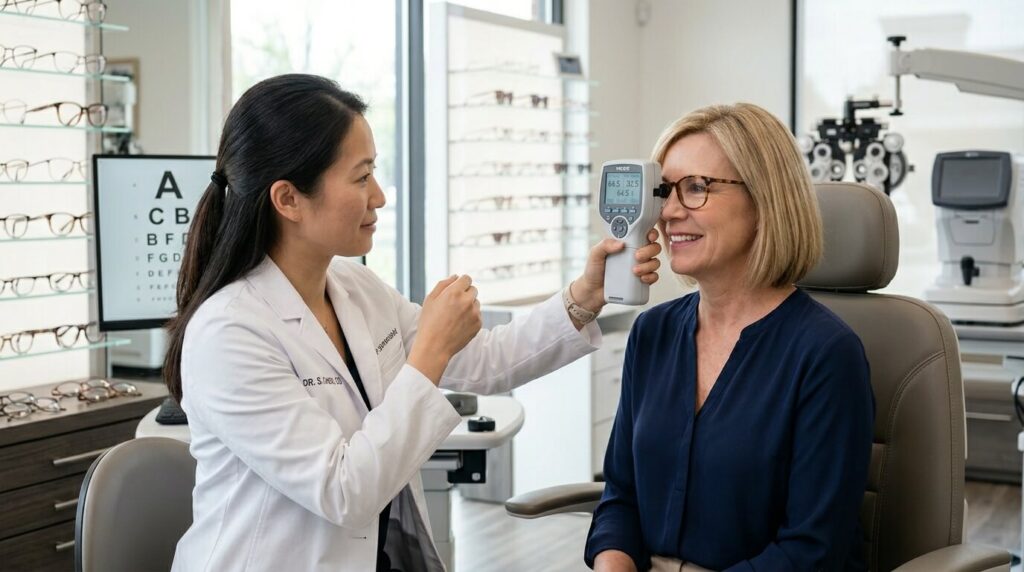
An up-to-date prescription is essential. Your optometrist or ophthalmologist will measure both your distance and near prescriptions and calculate the “add power” — the extra magnification needed for reading. They’ll also assess which of your eyes is dominant, which is used in premium lens manufacturing.
Step 2: Frame Selection
Frame choice significantly impacts your progressive lens experience. Recommendations:
- Adequate vertical height: Most standard progressives need at least 28–30mm of vertical lens space. Short corridor progressives can fit smaller frames.
- Avoid very narrow or very small frames for your first pair of progressives.
- Consider wrap angle: Highly curved (wrap) sports frames require customization to work correctly with progressives.
Step 3: Precise Measurements
Your optician will measure your pupillary distance (PD), fitting height (where the progressive center should sit relative to your pupil), and for premium lenses, additional parameters including pantoscopic tilt and frame wrap angle.
Step 4: Lens Ordering and Fabrication
Standard progressives can be produced relatively quickly. Personalized freeform lenses require lab computation and may take longer.
Step 5: Fitting and Dispensing
When you pick up your glasses, your optician should verify the fitting height and optical centers are correct. This is the most critical quality check in the process.
Progressive Lenses for Specific Lifestyles
Office Workers and Screen Users
Digital eye strain is a major concern for people who spend 6+ hours per day on screens. Computer progressive lenses with a wider intermediate zone, combined with anti-reflective and blue light filtering coatings, provide substantial relief compared to general-purpose progressives.
Drivers
For frequent drivers, a distance-weighted or task-specific driving progressive lens improves clarity of road, mirrors, and dashboard simultaneously. Anti-reflective coating is essential for night driving comfort.
Outdoor Enthusiasts and Athletes
Polarized photochromic progressive lenses or sport-specific progressive designs offer the best combination of UV protection, glare control, and appropriate focal zone distribution for active lifestyles.
First-Time Progressive Wearers
Those who have never worn multifocal lenses benefit most from advanced personalized freeform progressives, which offer the widest clear zones and shortest adaptation period, even at higher cost.
Children and Young Adults with Myopia
Progressive lenses (specifically myopia-control designs) may help slow the progression of nearsightedness in children. This is an active area of optometric research. If your child’s myopia is worsening rapidly, discuss progressive myopia management options with their eye care provider.
Progressive Lenses vs. Other Vision Correction Options
Progressive Lenses vs. Bifocals
| Factor | Progressive Lenses | Bifocals |
|---|---|---|
| Visible lines | No | Yes (1 line) |
| Intermediate vision | Yes | No |
| Image jump | None | Present |
| Adaptation difficulty | Moderate | Low |
| Cost | Higher | Lower |
| Appearance | More discreet | Lines visible |
Progressive Lenses vs. Trifocals
Trifocals add an intermediate zone to bifocals but retain two visible lines and still produce image jump at zone transitions. Progressive lenses provide the same three focal zones without lines or image jump, though at higher cost.
Progressive Lenses vs. Reading Glasses (Over-the-Counter)
OTC reading glasses provide a uniform magnification for close work only. They are not prescription-customized, offer no distance correction, and produce severe blurring for anything beyond arm’s reach. They are not a suitable replacement for progressive lenses in people who need vision correction at multiple distances.
Progressive Lenses vs. Multifocal Contact Lenses
Multifocal contact lenses are available for presbyopia and provide freedom from glasses. However, they typically offer less crisp vision across all zones compared to well-fitted progressive glasses and are more demanding in terms of maintenance and handling. They are an excellent complement or alternative to progressive eyeglasses for many wearers.
Common Problems with Progressive Lenses and How to Solve Them
Problem: Blurry near vision Possible cause: Incorrect fitting height, wrong add power, or looking too high in the lens. Solution: Check fitting with your optician. For reading, consciously look through the lower third of the lens and adjust your chin angle.
Problem: Difficulty with computer work Possible cause: The intermediate zone in general-purpose progressives may be too narrow for sustained screen use. Solution: Consider a dedicated pair of computer progressive lenses for desk use.
Problem: Dizziness or nausea when walking Possible cause: Normal adaptation response, or the progressive fitting height is off. Solution: This typically resolves in 1–2 weeks. If it persists, return to your optician for a fitting check.
Problem: Poor peripheral vision Possible cause: Inherent in all progressive lens designs; more pronounced in conventional lenses. Solution: Upgrade to advanced freeform lenses, which offer significantly reduced peripheral distortion.
Problem: Headaches Possible cause: Prescription error, incorrect PD, or muscle strain from adapting to new zones. Solution: Contact your eye care provider if headaches persist beyond 2 weeks.

FAQ: Progressive Lenses
Q: What are progressive lenses used for?
Progressive lenses correct vision at multiple distances simultaneously — near, intermediate, and far — in a single pair of glasses, without the visible lines found in bifocals or trifocals. They are most commonly used for presbyopia, the age-related difficulty focusing on close objects.
Q: At what age do people typically get progressive lenses?
Most people are first prescribed progressive lenses between ages 40–50, when presbyopia typically develops. However, some individuals get them earlier or later depending on their vision health.
Q: How long does it take to get used to progressive lenses?
Most people adapt within one to two weeks of consistent wear. Some take up to 4–8 weeks. A small percentage of wearers never fully adapt and may return to bifocals or separate glasses.
Q: Are progressive lenses worth the extra cost over bifocals?
For most modern wearers — particularly those who spend time on computers — the intermediate vision zone and line-free appearance make progressives well worth the additional cost. The value depends largely on your lifestyle and visual demands.
Q: Can progressive lenses be made in any frame?
Not every frame is suitable. You generally need a frame with sufficient vertical height (28mm+) for standard progressives. Short-corridor progressives fit smaller frames, but with some optical trade-offs. Very narrow or very small frames are not ideal for progressive lenses.
Q: Do progressive lenses work for astigmatism?
Yes. Progressive lenses can incorporate astigmatism correction (cylinder power) within the multifocal design.
Q: Are there progressive contact lenses?
Yes. Multifocal contact lenses function similarly to progressive glasses, providing correction at multiple distances. They are available in both soft and rigid gas-permeable designs.
Q: Why are my progressive lenses making me dizzy?
Mild dizziness is a normal part of the adaptation period and usually resolves within 1–2 weeks. If it persists, your fitting height or PD measurement may need adjustment. Return to your optician.
Q: Can I drive with progressive lenses?
Yes, and most people do. The upper portion of a progressive lens corrects distance vision used for driving. If you struggle specifically with driving, a task-specific driving progressive may help.
Q: Do progressive lenses block blue light?
Not inherently. Blue light filtering requires a specific coating applied to the lens surface, or a blue-light-blocking lens material. Ask your optician to add a blue light filter coating when ordering.
Q: What is the difference between premium and standard progressive lenses?
Standard progressives use conventional manufacturing with minimal customization. Premium (advanced freeform) progressives are digitally computed and personalized using detailed measurements of your eyes, face, and frame. Premium lenses offer wider clear zones, less distortion, and faster adaptation.
Q: How often should I replace my progressive lenses?
Whenever your prescription changes significantly, typically every 1–2 years. You should have annual eye exams to monitor your prescription. Lenses should also be replaced if they become scratched, the coatings degrade, or the frame no longer fits properly.
Q: Are progressive lenses bad for your eyes?
No. Progressive lenses do not damage your eyes or accelerate vision changes. They simply correct existing refractive errors and help your eyes function comfortably at multiple distances.
Q: Why are progressive lenses so expensive?
The optical engineering and manufacturing precision required for progressive lenses — particularly advanced freeform designs — is significantly more complex than for single-vision lenses. Premium materials, coatings, and personalization add further cost.
Q: Can children wear progressive lenses?
Yes. In some cases, progressive lenses are prescribed for children with myopia to help slow its progression, or for children with accommodative esotropia (a type of eye misalignment caused by focusing effort).