Searching for the best fitness routine for weight loss can feel like drinking from a firehose. One expert says run every day. Another swears by lifting heavy. A third tells you HIIT is the only thing that works. The truth? They’re all partially right — and the research finally shows us how to combine them properly.
This guide cuts through the noise with a complete, science-backed fitness routine for weight loss that works for beginners and experienced exercisers alike. You’ll get the why behind each approach, a flexible weekly schedule, and strategies to keep making progress when results slow down. What are early signs of gestational diabetes?
[E-E-A-T Note: Recommend adding a byline from a certified personal trainer (CPT) or registered dietitian here, along with a medical review note for credibility. Example: “Reviewed by [Name], CSCS, CPT.”]
Why Most Workout Plans Fail to Produce Lasting Weight Loss
The reason most people don’t get results from their fitness routine isn’t laziness — it’s poor programming. Walking on a treadmill for 45 minutes every day burns calories, but it doesn’t build the metabolic infrastructure that makes fat loss sustainable. Without muscle, your metabolism adapts downward, and progress stalls.
The most effective fitness routines for weight loss share three elements: resistance training to build or preserve lean muscle, cardiovascular work to create a calorie deficit, and structured recovery to let your body adapt. Remove any one of the three and results suffer.
Fat Loss vs. Weight Loss — Why the Difference Matters
Before diving into the plan, a critical distinction: weight loss and fat loss are not the same thing. The number on the scale can drop because you’ve lost water, muscle, or fat. Only fat loss improves your body composition and keeps you looking and feeling better long-term.
The goal of this routine is fat loss specifically — reducing body fat percentage while preserving or building lean muscle. That means the scale might move slowly some weeks even as your body is visibly changing. Progress photos and body measurements are more informative than scale weight alone.
The Foundation: Strength Training for a Higher Resting Metabolism
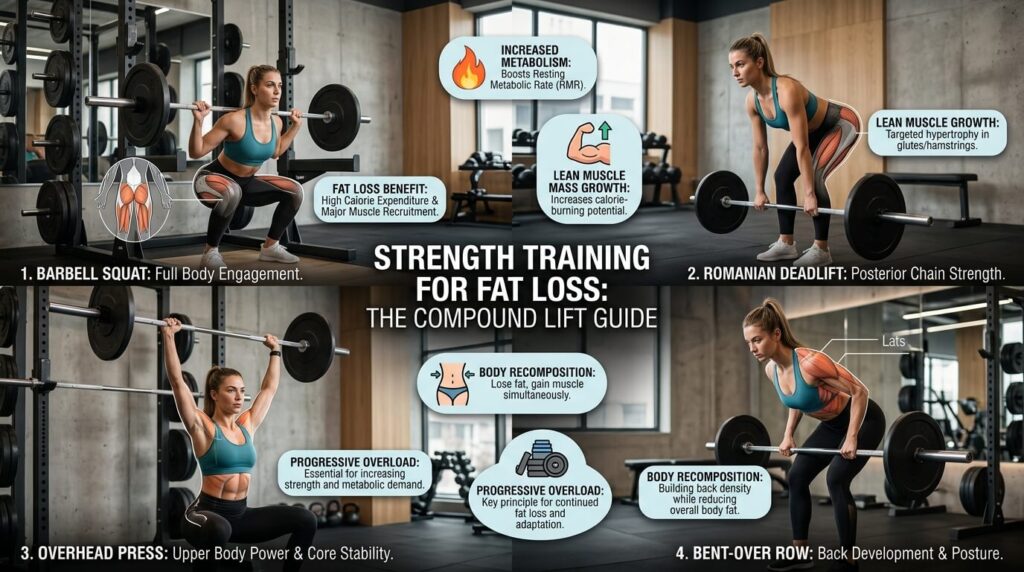
Strength training is the cornerstone of any effective fat-loss plan — not because lifting weights burns a huge number of calories during the session, but because building lean muscle tissue raises your resting metabolic rate (RMR). More muscle means your body burns more calories at rest, 24 hours a day.
A network meta-analysis published in a peer-reviewed journal found that aerobic exercise produced the greatest absolute weight loss, while HIIT was most effective at reducing body fat percentage and waist circumference — but both outperformed no-exercise controls by a wide margin. Combining them yields the best of both worlds. (Citation placeholder: link to the 2024 network meta-analysis in Frontiers in Physiology or similar — see [External Source 1].)
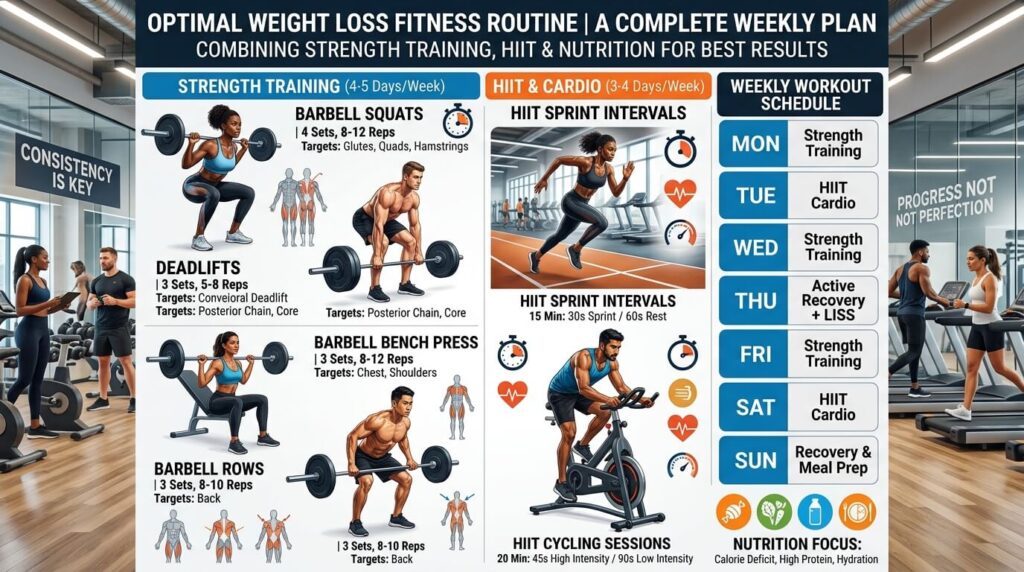
The Best Compound Exercises for Fat Loss
Compound movements recruit multiple muscle groups simultaneously, burning more energy per rep and triggering greater hormonal responses. For a weight loss workout plan, these are your highest-return exercises:
- Barbell or goblet squat — quads, glutes, hamstrings, core
- Romanian deadlift — posterior chain, glutes, lower back
- Bench press or dumbbell press — chest, shoulders, triceps
- Bent-over row or cable row — back, biceps, rear delts
- Overhead press — shoulders, triceps, upper back
- Hip thrust — glutes and hamstrings with minimal joint stress
Isolation exercises (bicep curls, calf raises) have their place, but build your sessions around compounds first.
How to Use Progressive Overload to Keep Burning Fat
Progressive overload is the gradual increase of stress placed on the body during exercise. It’s the single most important principle for continued fat loss results. Without it, your body adapts to your current workouts and stops changing.
Progressive overload doesn’t always mean adding weight. You can progress by:
- Increasing reps at the same weight (e.g., 3×8 → 3×10)
- Decreasing rest time between sets
- Adding sets (volume)
- Slowing the lowering phase (eccentric tempo)
Track your workouts in a notebook or app. If you’re lifting the same weights for the same reps month after month, your routine has become maintenance — not progress.
Sets, Reps, and Rest Periods for Weight Loss
For fat loss, a rep range of 8–15 works well for most people because it balances muscle stimulus with caloric expenditure. Rest periods of 45–75 seconds between sets keep your heart rate elevated compared to powerlifting-style 3-minute rests.
A practical template per session:
- 3–4 compound exercises × 3–4 sets × 8–12 reps
- 1–2 accessory exercises × 2–3 sets × 12–15 reps
- Total session: 45–60 minutes
Cardio That Actually Burns Fat: HIIT vs. Steady-State
Cardiovascular exercise creates the calorie deficit that drives fat loss. But not all cardio is equally effective — and choosing the wrong type at the wrong time can undermine your recovery and progress.
The Afterburn Effect (EPOC) Explained
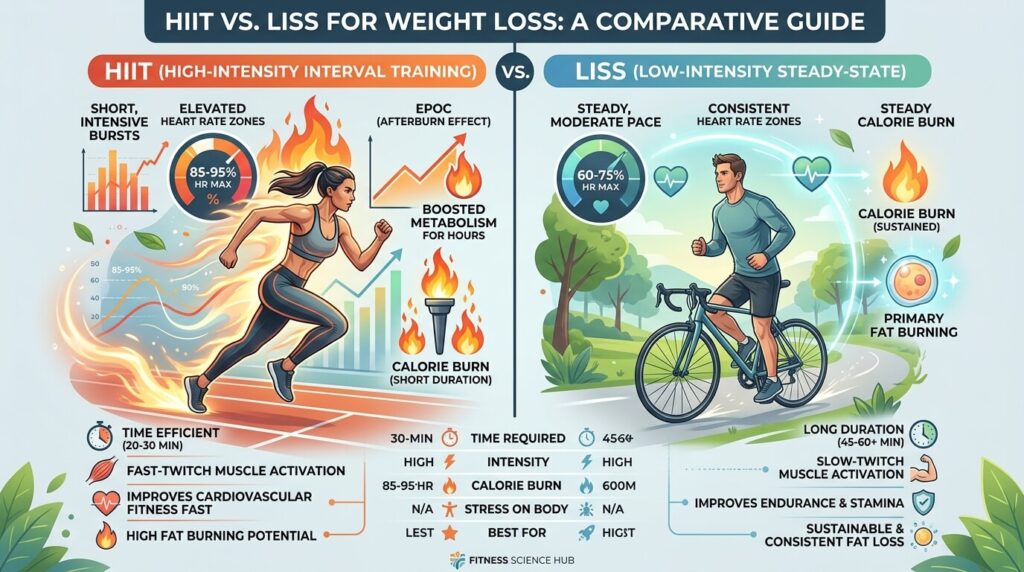
HIIT stands for High-Intensity Interval Training: short bursts of near-maximal effort (20–40 seconds) alternating with brief rest periods. Its key advantage over steady-state cardio is a phenomenon called Excess Post-Exercise Oxygen Consumption, or EPOC — often called the “afterburn effect.”
After an intense HIIT session, your body continues consuming elevated oxygen (and therefore calories) for up to 24 hours as it repairs tissue, restores glycogen, and returns systems to baseline. Research consistently shows HIIT reduces body fat percentage and waist circumference more effectively than moderate-intensity steady-state cardio of equal duration. (Citation placeholder: link to the 2025 systematic review in PMC/NCBI — [External Source 2].)
A simple HIIT template:
- 5-minute warm-up (light jog or bike)
- 30 seconds at 85–95% max effort (sprint, row, bike sprint, burpees)
- 60 seconds active rest (walk, slow pedal)
- Repeat 8–10 rounds
- 5-minute cool-down
Low-Intensity Steady-State (LISS) Cardio: When and Why
LISS — walking, easy cycling, or swimming at 50–65% max heart rate for 30–60 minutes — isn’t inferior to HIIT; it serves a different purpose. LISS is ideal for:
- Active recovery days (gets blood flowing without taxing the nervous system)
- Beginners building an aerobic base before attempting HIIT
- Anyone with joint issues or high training fatigue
- Adding extra calorie burn without adding recovery demand
The best fat-burning fitness routines use both: HIIT 2x per week for intensity, LISS 1–2x per week for volume and recovery.
Heart Rate Zones for Optimal Fat Burning
The “fat-burning zone” (55–65% max heart rate) burns a higher percentage of calories from fat, but higher-intensity zones burn more total calories — and total calorie burn is what drives weight loss. Use the fat-burning zone for LISS sessions and push into zones 4–5 (80–95% max HR) during HIIT.
A rough max heart rate formula: 220 – your age. A 35-year-old’s target HIIT zone is approximately 153–175 BPM.
Body Recomposition — Losing Fat While Building Muscle
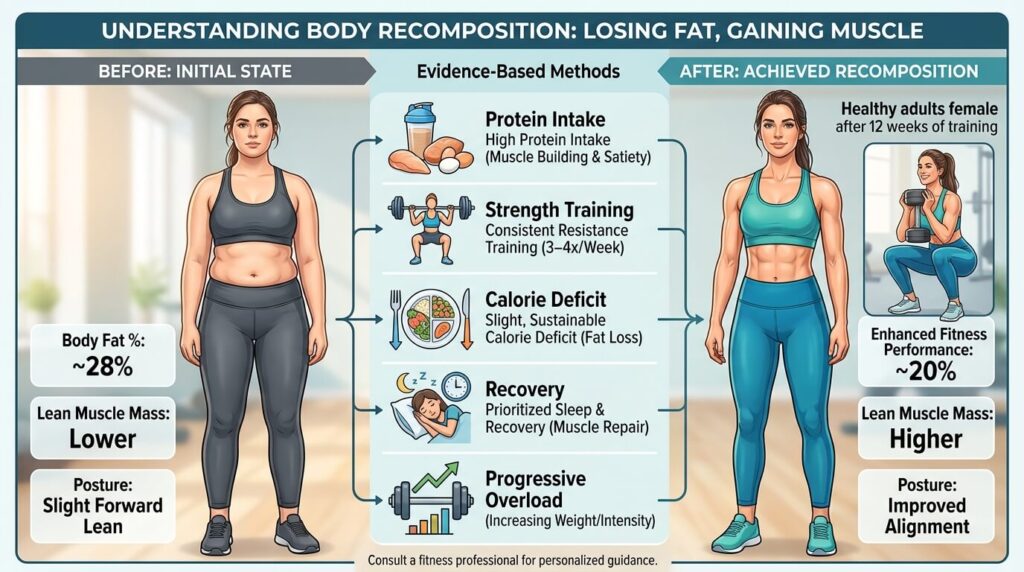
Body recomposition — simultaneously reducing fat and increasing lean muscle — was once considered impossible for anyone but beginners. Newer research suggests it’s achievable for a broader range of people, particularly those returning to training after a break or those in a slight calorie deficit with sufficient protein intake.
For recomposition to work, three things must align:
- A modest calorie deficit (200–300 calories below maintenance, not a crash diet)
- High protein intake (0.7–1.0g per pound of body weight)
- Consistent progressive overload in the gym
If you’re a beginner to strength training, you’re in the best possible position: “newbie gains” allow muscle building and fat loss to happen simultaneously even without perfect nutrition.
Your Weekly Fitness Routine for Weight Loss (3, 4, and 5-Day Options)
Choose the schedule that fits your life — consistency beats perfection every time.
3 Days Per Week (Beginner / Busy Schedule)
| Day | Focus |
|---|---|
| Monday | Full-body strength (compound focus) |
| Wednesday | HIIT cardio (20–25 min) + core work |
| Friday | Full-body strength (different compound set) |
4 Days Per Week (Intermediate)
| Day | Focus |
|---|---|
| Monday | Lower body strength |
| Tuesday | HIIT cardio (25–30 min) |
| Thursday | Upper body strength |
| Saturday | LISS cardio (30–45 min) + mobility |
5 Days Per Week (Advanced / Dedicated)
| Day | Focus |
|---|---|
| Monday | Lower body strength |
| Tuesday | HIIT cardio (25–30 min) |
| Wednesday | Upper body strength |
| Thursday | LISS cardio (30–40 min) or active recovery |
| Friday | Full-body strength (metabolic focus) |
| Saturday/Sunday | Rest or light activity |
Key Rule: Never do HIIT two days in a row. The nervous system needs 48 hours to recover from high-intensity work. If you miss a session, skip it — don’t double up.
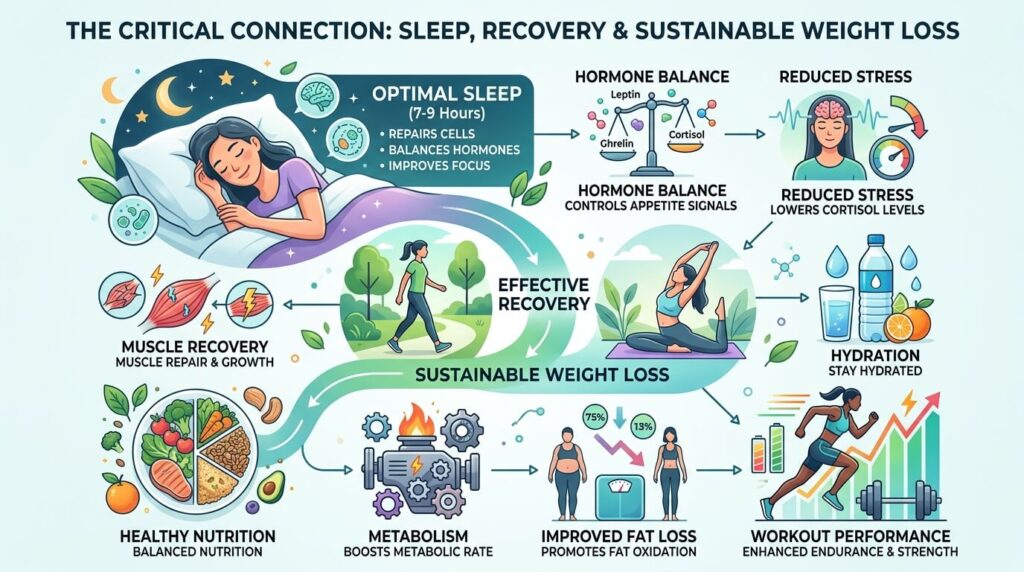
Recovery and Sleep: The Two Most Underrated Fat-Loss Tools
Most fitness content glosses over recovery. That’s a mistake — it may be the highest-leverage variable in your weight loss plan.
Sleep is when growth hormone is released, muscle tissue is repaired, and hunger-regulating hormones (leptin and ghrelin) are balanced. Chronic sleep deprivation increases ghrelin (hunger hormone) by up to 28% and reduces leptin (satiety hormone), making calorie control dramatically harder regardless of how well you train. Aim for 7–9 hours per night.
Active recovery — light walking, stretching, or yoga on rest days — reduces muscle soreness and improves blood flow without adding recovery debt. It also keeps your step count and daily calorie burn elevated on non-gym days.
Skipping recovery to train more is one of the most common mistakes in fat-loss programming. Overtraining elevates cortisol, which can trigger fat storage — particularly around the abdomen — and increase injury risk.
Nutrition Basics to Maximize Your Workout Results
No fitness routine for weight loss works without nutritional support. You don’t need a complicated diet — but you do need a few non-negotiables.
Calorie deficit: Fat loss requires consuming fewer calories than you expend. A deficit of 300–500 calories per day produces roughly 0.5–1 lb of fat loss per week — a sustainable and realistic target that preserves muscle mass.
Protein: The most important macronutrient for body composition. Aim for 0.7–1g of protein per pound of body weight daily. Protein keeps you full, supports muscle repair, and has the highest thermic effect of any macronutrient (meaning your body burns more calories just digesting it).
Pre/post-workout nutrition: A small meal with carbohydrates and protein 1–2 hours before training improves performance. Post-workout, prioritize protein within 1–2 hours to support muscle recovery.
Hydration: Even mild dehydration (1–2% of body weight) impairs strength, endurance, and cognitive function. Aim for at least 2–3 liters of water daily, more on training days.
How to Track Progress (and What to Do When You Plateau)
Weighing yourself daily and averaging over the week is more informative than single weigh-ins. But scale weight alone misses important changes. Use multiple metrics:
- Body measurements (waist, hips, thighs) every 2 weeks
- Progress photos in consistent lighting every 4 weeks
- Strength metrics (are you lifting more than you were 6 weeks ago?)
- Energy and sleep quality — subjective but real indicators
When you plateau (no change for 2–3 weeks): Don’t slash calories further. Instead, try:
- Increasing training volume (add one set per exercise)
- Changing cardio format (if you’ve been doing LISS, swap to HIIT)
- Auditing your diet for hidden calorie creep
- Adding a deliberate “diet break” at maintenance calories for 1 week to reset metabolic adaptation
FAQ — Fitness Routine for Weight Loss
Q: What is the best exercise routine to lose weight fast?
A: The fastest sustainable results come from combining 2–3 strength training sessions with 2 HIIT sessions per week, supported by a modest calorie deficit (300–500 cal/day). Extreme approaches produce quick initial results but are hard to maintain and often lead to muscle loss.
Q: How many days a week should I work out to lose weight?
A: 3–5 days is the sweet spot for most people. Three days per week of structured training can produce excellent results if intensity and nutrition are dialed in. More than 5 days risks overtraining without additional benefit for most non-athletes.
Q: Is strength training or cardio better for weight loss?
A: Both serve different functions. Cardio creates immediate calorie deficit; strength training raises your resting metabolic rate for long-term fat loss. Research consistently shows that combining both outperforms either alone.
Q: What is the afterburn effect, and does it actually help with weight loss?
A: EPOC (Excess Post-Exercise Oxygen Consumption) is the elevated calorie burn that continues after intense exercise as your body recovers. Studies show it can last up to 24 hours after HIIT and adds meaningfully to total weekly calorie expenditure — making HIIT more efficient per minute than steady-state cardio.
Q: Can I lose weight without doing cardio?
A: Yes, if your calorie deficit is achieved through diet and strength training alone. However, cardio improves cardiovascular health, fitness, and recovery capacity — benefits that go well beyond fat loss. Most people find it easier to lose fat with some cardio included.
Q: How long does it take to see results from a fitness routine?
A: Most people notice improved energy and strength in 2–3 weeks. Visible body composition changes typically appear after 4–8 weeks of consistent training and nutrition. Significant fat loss (5–10+ lbs) generally takes 8–16 weeks depending on starting point and adherence.
Q: What should I eat when trying to lose weight with exercise?
A: Prioritize protein at every meal (aim for 0.7–1g per lb of body weight daily), fill half your plate with vegetables, and include moderate amounts of complex carbohydrates around your workouts. Minimize ultra-processed foods, which are easy to overeat.
Q: Is a 30-minute workout enough to lose weight?
A: Absolutely. A well-designed 30-minute strength or HIIT session can be highly effective, especially for beginners. What matters most is intensity and consistency, not duration.
Your Next Step
The best fitness routine for weight loss is the one you’ll actually stick to. Start with the 3-day beginner schedule if you’re new to structured training. Add complexity as your fitness improves. Keep progressive overload in your strength sessions, mix HIIT and LISS cardio, prioritize sleep, and let nutrition do the heavy lifting on your calorie balance.
Fat loss is a long game — but it compounds. Six months of consistent effort with this plan will produce more lasting change than any crash program ever could.